
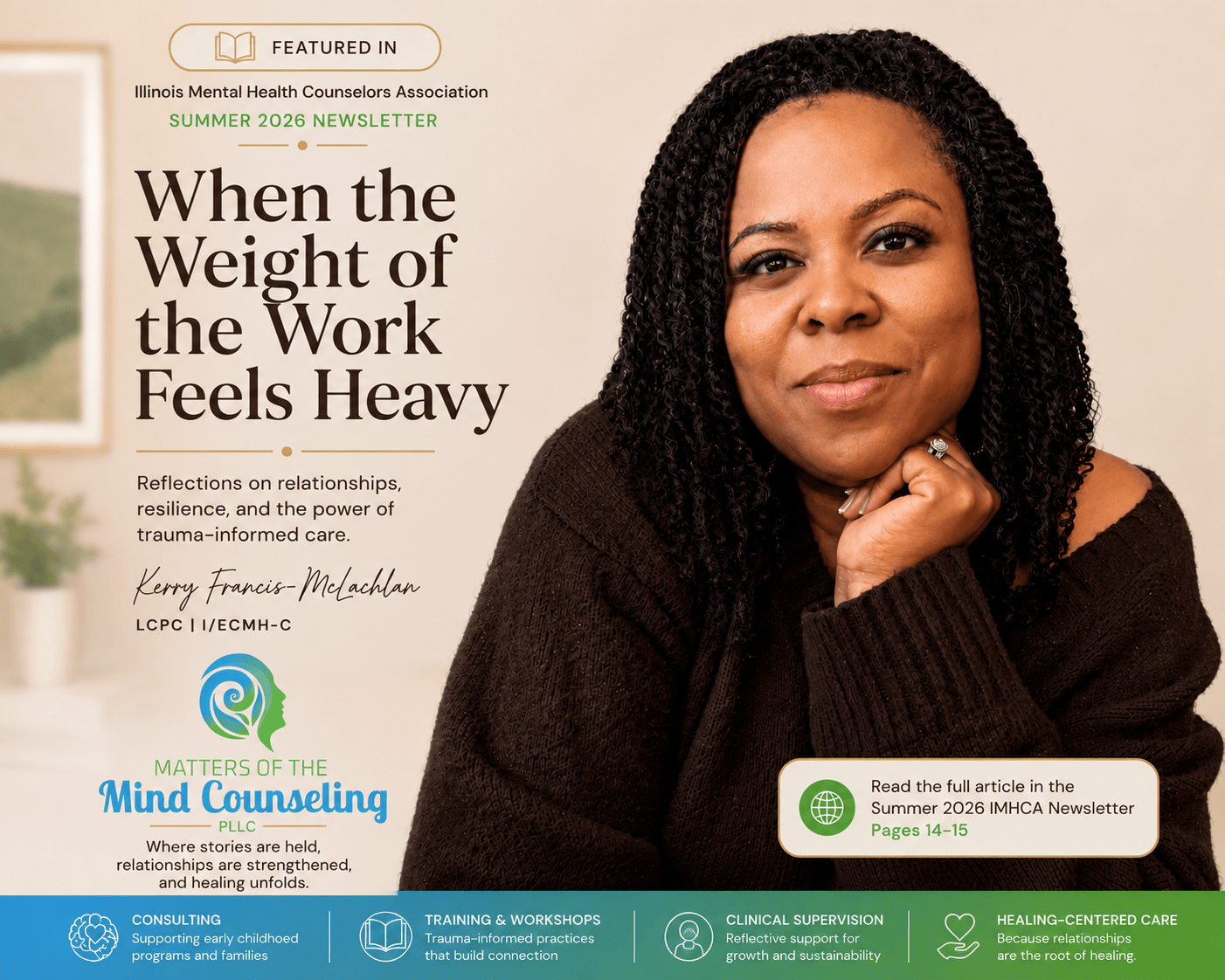
By Kerry Francis-McLachlan, LCPC, I/ECMH-C
Originally published in the Illinois Mental Health Counselors Association (IMHCA) Summer 2026 Newsletter
Some articles are written because we have something to teach. Others are written because something reminds us why we chose this work in the first place.
When the Weight of the Work Feels Heavy was inspired by one of those moments. I recently watched a short video of an aunt dancing with her two-year-old nephew. As an infant, she had held him and danced with him to the same song whenever he needed comfort. Nearly a year later, when that familiar song began to play again, he instinctively walked over, lifted his arms, and asked to be held.
Watching that moment reminded me of something I have witnessed throughout my years working with children and families:
Children remember relationship long before they can explain it.
It also reminded me why this work can sometimes feel heavy and why it continues to matter.
I am honored to share this article, originally published in the Illinois Mental Health Counselors Association Summer 2026 Newsletter, in hopes that it encourages clinicians, educators, caregivers, and anyone who holds space for children and families.
Today my heart feels a little heavy. Ironically, it was not a story of trauma or hardship that brought me here. It was a story of connection.
I recently watched a short heartfelt video online of an aunt dancing with her two-year-old nephew in the kitchen. When he was a baby, from the time he was born until his first birthday, she would hold him and dance with him to a particular song whenever he needed comfort and soothing. It became part of their relationship, part of the rhythm they shared together. After his first year, the song was rarely played.
Then one day, when he was two years old, his mother happened to play the song while his aunt was visiting. The moment the music began, he stopped in his tracks. Without hesitation, he walked over to his aunt, lifted his arms, and asked to be picked up. Something about the song and the experience seemed deeply familiar to him.
As his aunt held him and danced with him once again, tears filled her eyes. Mine too.
As I watched, I found myself thinking about something often discussed in infant and early childhood mental health: children are shaped by experiences and relationships long before they have the words to describe them. What struck me most was not simply his response to the song.
It was what the experience represented: safety, comfort, connection, and relationship.
The experience reminded me of why I do this work. Because every day I encounter children and families carrying tremendous burdens. I see the effects of trauma, loss, chronic stress, poverty, violence, and experiences that often span generations. I see children communicating needs they do not yet have words for. I see parents doing their best while carrying wounds of their own.
Some days the weight of that reality feels overwhelming.
There is so much pain carried within our communities. Pain that can be held in bodies, relationships, and stories passed from one generation to the next. Pain that can shape how we see ourselves, connect with others, and respond to the children in our care. And yet, amidst all of that, I am reminded that something else is passed down too: connection, love, safety, and moments of attunement.
Moments when a child feels seen, known, safe, and protected. The little boy in that video reminded me that relationships matter more than we often realize. The loving interactions we share with children become part of them. They help shape expectations about relationships, safety, and belonging. They influence how children learn to seek comfort, regulate emotions, and connect with others.
Perhaps that is why the work feels heavy sometimes. Because I know what is possible. I know the power of a nurturing relationship. I know that moments of comfort and connection can leave lasting impressions. I know that children who experience consistent love and safety carry those experiences forward, just as children may carry experiences of fear, uncertainty, and hurt.
The reality is that healing rarely happens through grand gestures. More often, it happens through ordinary moments: a teacher who pauses before reacting, a parent who takes a breath and tries again, a caregiver who offers connection before correction, or an aunt dancing with her nephew in the kitchen.
These moments may seem small, but they matter. In fact, they may matter more than we know.
So today, while my heart feels heavy, it is also filled with hope. Because if a two-year-old can respond so strongly to an experience associated with being held, soothed, and loved, then perhaps we should never underestimate the power of the moments we create with children.
The work is hard. The need is great. But relationships matter.
And sometimes the smallest moments leave the deepest imprint. So, I will continue to show up.
Holding onto hope. Holding space for healing. And holding space for you as well.
Thank you for taking a few moments to read this reflection. I hope it encourages you to pause, notice, and never underestimate the lasting impact of the relationships you build every day.

What ordinary moment has reminded you of the power of connection? I'd love to hear your reflections in the comments.

Until next time and be well,


Kerry Francis-McLachlan
Founder, Matters of the Mind Counseling
Meet the Author
Kerry Francis-McLachlan, LCPC, I/ECMH-C is the founder of Matters of the Mind Counseling, where she provides infant and early childhood mental health consultation, reflective supervision, professional development, and trauma-informed therapy. Her work centers on the belief that relationships are among the most powerful agents of healing.
→ Learn more about Kerry and the mission of Matters of the Mind Counseling.
 Kerry McLachlan